Introducing Domistra™ : Property Management, Connected
Property management rarely happens in a straight line.
A resident reports a problem. The Property Manager needs to understand the issue, identify the property and unit, determine who is responsible, decide whether approval is required, coordinate a vendor, keep the right people informed, track the cost and make sure the work is actually completed.
Meanwhile, rent is being collected. Leases are approaching expiry. Inspections are due. Landlords need updates. Documents require signatures. Payments need reconciling. Team members have tasks waiting for approval.
The difficulty is not that these activities exist. It is that they are connected.
Yet Property Managers are often left to make those connections themselves - moving between software, spreadsheets, emails, messages, documents and people to keep the operation running.
Domistra is being built differently.
It brings the people, information, finances and workflows behind property management into one connected ecosystem. Not simply so Property Managers can keep better records, but so they can run better property operations.
September 28, 2026
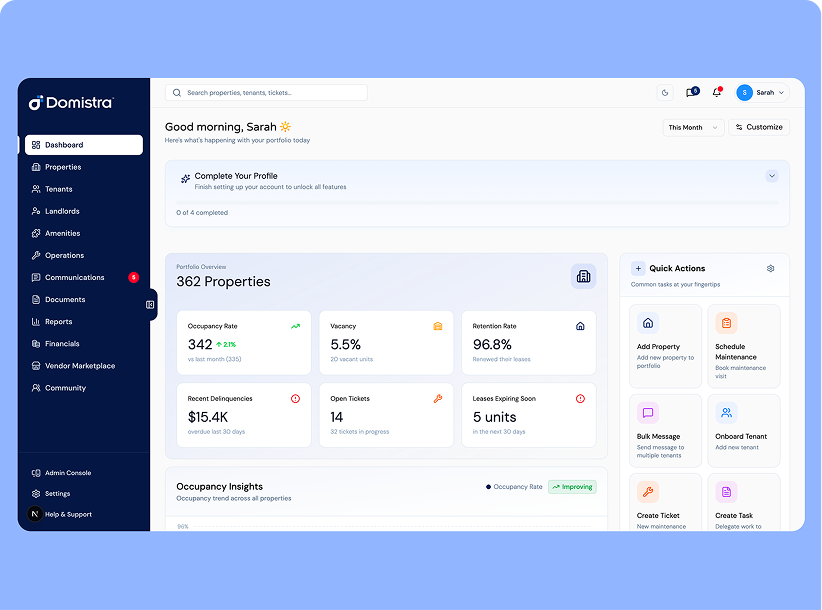
Property management is an ecosystem
A managed property sits at the centre of several relationships.
There is the Property Manager responsible for the operation. The landlord whose asset is being managed. The resident occupying the property. The vendors providing services. And the internal team responsible for leasing, finance, maintenance, inspections, approvals and administration.
Each person has a different role, but they are often working around the same underlying information.
A lease affects financial obligations. An inspection may identify maintenance work. Maintenance may require approval, a vendor and an expense. A landlord agreement determines the management relationship. A payment needs to be connected to the correct obligation, property and party. A document may belong to a property, landlord, resident, lease, transaction or maintenance activity.
Domistra is designed around these relationships.
At the centre is the Property Manager's operational workspace. Around it are dedicated experiences for residents, landlords, vendors and other users - connected to the same property ecosystem while providing each person with the information and actions relevant to them.
The objective is straightforward: information should not lose its context simply because it moves from one workflow or person to another.
See the operation, not just the records
A Property Manager should not have to open six modules to understand what is happening across a portfolio.
Domistra brings operational information together to give teams a clearer view of their properties and the activities around them.
From the portfolio dashboard, Property Managers can see information across properties and units, financial activity, leases, maintenance, inspections, tasks and other areas requiring attention. Portfolio and location views provide another way to understand the assets under management, while operational indicators help surface patterns, outstanding activities and exceptions that warrant investigation.
But a dashboard is only useful if it leads somewhere. The objective is not to fill the screen with charts. It is to help a Property Manager answer three questions quickly:
What is happening?
What needs my attention?
What should happen next?
Connect the complete property relationship
A property is more than an address in a database.
There may be a landlord whose relationship with the Property Manager is governed by a management agreement. The property may contain several units. A unit may have an active lease. That lease connects to residents, financial obligations, documents, inspections and other operational activity.
Domistra brings those relationships together.
Landlord -> Management Agreement -> Property -> Unit -> Lease -> Resident
Financials -> Maintenance -> Inspections -> Documents -> Tasks -> Communications -> Vendors
This creates a more useful operational history. Instead of viewing a resident as a contact record, the wider context of that tenancy can include the relevant unit and lease, financial activity, documents, maintenance requests, inspection information and other actions associated with the relationship. When information is connected properly, teams spend less time reconstructing context before they can make a decision.
Manage landlords as clients, not simply names attached to properties
For a professional Property Manager, a landlord is not merely an owner field on a property record. The landlord is a client.
That relationship begins before day-to-day property management does. Domistra is designed to support the management relationship from onboarding and the management agreement through to the properties under management, documents, financial activity, maintenance visibility, reporting, remittances and ongoing communication.
Contracts are part of that operating process. For example, where a management agreement is required before a landlord can be onboarded into the management relationship, the contract workflow can support the agreement, signing process and resulting record.
The Landlord Workspace extends that relationship further by giving landlords access to relevant information about their managed properties without requiring the Property Manager to manually redistribute every routine update.
The aim is greater transparency without giving up operational control.
Run property finances with greater control
Property-management finance is not simply about collecting rent. Money received by a Property Manager can have different purposes, obligations and accounting treatment.
Domistra's financial architecture is being designed around that reality.
Property Managers can manage the financial activities associated with their portfolios, including tenant receivables, charges, payments, outstanding balances and the allocation of money received. The wider financial model also supports the distinct treatment required for areas such as security deposits, service charges, sinking funds, owner payables, landlord remittances and Property Management fees.
That distinction matters. Knowing that $2,500 was received is only part of the story. A property-management system should also help establish:
Who paid it? What was it for? Which property or unit does it relate to?
How should it be allocated? What remains outstanding? What should happen to the money next?
Plan for tomorrow's property expenditure
Good property management is not limited to recording what has already happened. Some expenditure can be anticipated.
A roof will eventually need replacing. Major equipment may reach the end of its useful life. Common areas may require refurbishment. Other significant capital works may be expected over the life of an asset. Domistra's approach to CapEx planning and sinking funds is intended to help Property Managers plan for those requirements rather than simply record the expense after it occurs.
A future capital requirement can be identified and, where appropriate, funds can be progressively set aside over time - from agreed property receivables or through direct landlord funding. Approval can also follow the organisation's operating model, including authorised internal approval or landlord approval where required.
What expenditure is coming, how are we preparing for it, and how will it be funded?
Turn maintenance requests into managed workflows
Receiving a maintenance request is the easy part. Managing everything that follows is where the work begins.
A resident may report an issue, but the Property Manager may still need to assess it, establish responsibility, determine whether approval is necessary, assign work, coordinate a vendor, communicate with the relevant parties, track costs and verify completion.
Domistra is designed to connect those stages. A maintenance issue can remain associated with the resident, unit and property throughout its lifecycle, while the operational workflow around it can bring together the people, actions and information required to reach resolution.
The result is not simply a list of open and closed tickets. It is a history of the issue and how it was handled.
Turn inspections into action
An inspection report has limited value if important findings disappear into a PDF afterwards.
Domistra treats inspection findings as part of the wider property operation. Property Managers can manage inspection activities, record the condition of the property, capture findings and produce the relevant inspection record.
Where a finding requires further action, the workflow should not end with the report. The issue can progress into the appropriate operational response, creating accountability for what needs to happen next. Residents can also receive relevant inspection reports where appropriate.
This connects property condition management to the work required to protect and maintain the asset.
Coordinate vendors without losing oversight
External service providers are an essential part of property operations. They can also become a major source of fragmented communication.
Instructions may be given by phone. Quotations arrive through email or WhatsApp. Approvals happen somewhere else. Completion evidence is sent separately. Invoices reach another member of the team. The Property Manager is left assembling the history.
Domistra's vendor coordination is designed to bring more structure to that process by connecting service activity to the property work that created it. That gives the Property Manager clearer oversight of what was required, who was involved, where the work stands and the records associated with it.
Importantly, this operational vendor relationship is distinct from Domistra's broader Marketplace experience for personal resident services.
Professional property-management work remains part of the managed property operation.
Keep documents where they make sense
Property management generates a considerable volume of documentation: leases, management agreements, inspection reports, property records, financial documents, vendor documentation, notices and correspondence.
Simply putting those files online does not solve the document problem. People still need to know where the document belongs and why it matters.
Domistra's document architecture is designed around business context. Documents can be associated with the relevant property relationships and activities rather than existing only as files inside folders.
Contracts add another layer. Where an agreement needs to be executed, the contract workflow can manage the parties and signing process, retain the completed agreement and preserve the relevant audit history.
The objective is to make documentation part of the property workflow - not an archive sitting beside it.
Turn events into responsibility
A significant amount of property management is follow-through.
A lease approaches expiry. An inspection identifies a defect. A quotation needs approval. A maintenance issue becomes urgent. A contract requires signature. A financial exception needs investigation.
Something has happened. What happens next?
Domistra's task, approval and escalation capabilities are designed to help convert operational events into accountable work. The appropriate person can be assigned responsibility. Decisions can follow defined approval routes. Outstanding actions can be tracked. Escalations can occur where necessary.
For a growing property-management organisation, this becomes increasingly important. The business should not depend on one experienced employee remembering everything that needs to happen.
Give every stakeholder the right window into the operation
Property Managers are not the only people interacting with a managed property.
Residents need information and services relating to their tenancy. Landlords need appropriate visibility into their assets. Vendors need enough information to perform assigned work. Internal employees need access appropriate to their responsibilities.
Giving all of these users the same interface would create more complexity, not less. Domistra therefore uses dedicated workspaces.
Residents can access relevant tenancy services through the Resident Workspace. Landlords can access appropriate property and financial information through the Landlord Workspace. Approved vendors can participate through their own experience. Property-management teams retain the operational environment required to run the portfolio.
Different experiences. Shared underlying context.
The Property Manager remains in control without having to become the messenger between every participant.
Control who can see and do what
As property-management organisations grow, access control becomes an operational requirement.
Not every member of staff should necessarily be able to see every property, access every landlord's information, approve financial activity, change a lease or perform sensitive administrative actions.
Domistra is being built with role-based access and organisational controls that allow responsibilities to be reflected in the system. Combined with approval workflows and audit history, this creates a stronger foundation for governance and accountability across property-management teams.
This matters particularly for organisations managing larger portfolios, multiple staff roles or more complex operating structures.
Bring an existing portfolio into Domistra without starting from zero
Adopting a new property-management platform should not mean manually rebuilding an entire portfolio one record at a time.
For established Property Managers, migration can be one of the biggest barriers to changing systems. Properties already exist. Units already exist. Landlords and residents already have relationships with the business. Active leases are already running.
Domistra's Fast Onboarding approach is designed to help Property Managers bring active portfolio information into the platform through a more consolidated process rather than recreating each part of the portfolio independently.
Spend less time rebuilding what you already know and more time using the platform to manage it.
Manage the portfolio wherever the work happens
Property management does not happen exclusively behind a desk.
Property Managers visit buildings. They conduct inspections. They deal with maintenance issues. They meet residents and vendors. They make decisions between appointments.
That is why Domistra's mobile experience is being designed around the work that matters when Property Managers are away from their desks.
Rather than attempting to squeeze every desktop administrative function onto a smaller screen, the mobile experience prioritises activities such as portfolio oversight, triage, approvals, tasks, maintenance, vendor coordination, lease actions and communication.
Heavier administration can remain on desktop. The operation can move with the Property Manager.
One Ecosystem. Different People. Connected Work.
The ambition behind Domistra is larger than putting property-management features into one application.
A Property Manager should be able to understand what is happening across the portfolio and move into the work requiring attention. A resident's maintenance request should retain its relationship to the tenancy and property as it moves through resolution. An inspection finding should be capable of becoming accountable work. A financial transaction should retain its purpose and property context. A landlord should receive appropriate visibility without creating another reporting burden for the Property Manager. A document should remain connected to the relationship or activity that gives it meaning. And as teams grow, responsibilities, approvals and access should be clear.
That is the operating environment we are building.
Domistra is not simply a system for storing property records. It is a connected property ecosystem designed to help Property Managers coordinate their portfolios, finances, teams, residents, landlords, vendors and the work between them.
And this is only the beginning.
As we launch Domistra and work with Property Managers in real operating environments, we will continue refining the platform around the problems that matter; where work gets stuck, where information becomes fragmented, where teams lose visibility and where unnecessary administration takes time away from managing property well.
Because better property technology should not give Property Managers another system to manage. It should help them manage the operation.
Welcome to Domistra.
Everything Connected. One Property Ecosystem.
Explore Domistra, join our Early Access programme